


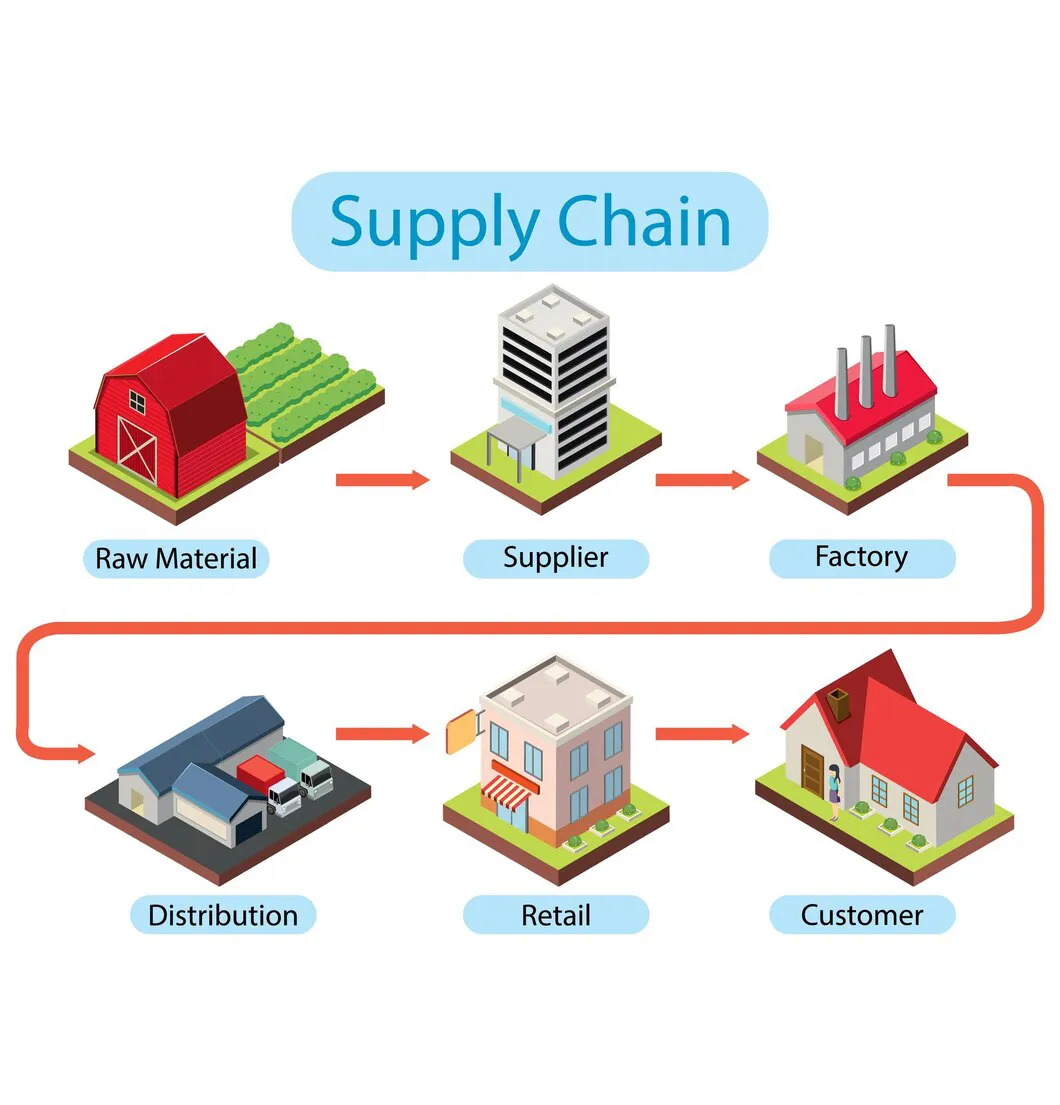
There is a logic to where things belong. I am speaking about a deep logic, one that Vastu Shastra has codified for over five thousand years: the logic of directional energy and its relationship to the nature of matter.
Raw materials and finished goods are not merely different stages of your production cycle. In the language of Vastu, they are fundamentally different energetic realities: one carrying the weight and potential of the earth, the other carrying the lightness and readiness of completed form. Where you store them determines whether that energy supports your factory’s prosperity or quietly works against it.
The nine zones and what they are built to hold
Before we speak specifically about raw material and finished goods, we must understand the directional map of a factory plot. Each of the eight directions governs a distinct quality of energy. It is a precise spatial science derived from the movement of the sun, the earth’s magnetic field, and the classical understanding of the five elements.
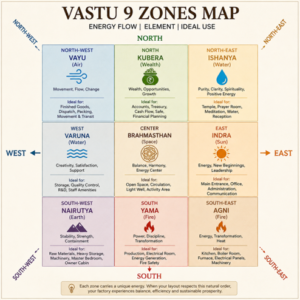
Now look at this map and ask yourself a simple question: which direction would you intuitively choose to store something heavy and yet to be transformed? The south-west answers immediately- Nairutya, the earth
element, governed by weight, permanence, and containment. This is where raw materials belong. And which direction carries the quality of outward movement, readiness, and transition? The north-west- Vayu, the air element, governed by flow, change, and departure. Finished goods, awaiting dispatch, belong here.
When your layout honours these natures, the factory stops fighting itself. Production flows with the grain of the space rather than against it. Inventory is accurate. Dispatch is timely. Workers are steady. And the owner, who has spent years wondering why the numbers never quite add up to the effort put in, begins to experience something that no management consultant has ever been able to manufacture: a factory that simply works.
Want Vastu guidance for your space?
Tell us about your home, office or shop in Dubai and we will get back to you.
Contact UsOur Vastu services in Dubai
- Vastu for Home
- Vastu for Offices
- Vastu for Shop & Showroom
- Vastu for Warehouses
- Vastu for Industries
- Vastu Consultant in Dubai
- Vastu FAQs